The COLDCARD RNG Incident Scared Me
I don’t own Bitcoin because I want excitement.
I own it because I see it as long-term savings — potentially retirement money for my wife and me.
And that makes self-custody feel very different.
When you are protecting a small amount of Bitcoin, losing it would hurt. When Bitcoin becomes a meaningful part of your retirement plan, a mistake could affect the next few decades of your life.
There is no bank manager to call.
No “forgot password” button.
No customer-service officer who can reverse a transaction.
There is just me.
That reality hit me much harder after reading about the recent COLDCARD RNG incident.
One Security Incident Was Enough to Make Me Uncomfortable
Coinkite disclosed that certain COLDCARD firmware versions had a problem affecting device-generated entropy used when creating seeds. The company advised users with affected seeds to migrate, although independently supplied dice entropy could provide protection depending on how it had been used. (COINKITE Blog)
I don’t use a COLDCARD for my main wallet.
I use Trezor.
So technically, this wasn’t my hardware-wallet problem.
But that wasn’t the lesson I took from it.
The lesson was much more uncomfortable:
The security of everything I own can ultimately begin with a random number generated inside a tiny electronic device.
If that randomness is truly strong, everything downstream is fine.
If it isn’t, the beautiful metal backup, carefully hidden seed words and strong physical security may not save you.
That scared me.
Then I Started Thinking About My Trezor
Trezor explains that wallet generation uses multiple entropy sources rather than relying on only one random-number generator.
For the Trezor Model One and Model T, Trezor says entropy from the host computer or phone is combined with hardware randomness from the STM32 microcontroller. Newer Trezor models add additional hardware entropy sources. (Trezor)
That architecture makes sense to me.
Trezor is also open source, so its firmware and hardware designs can be inspected by researchers. (Trezor)
But as an ordinary user, there is still a psychological problem.
I cannot personally look inside my individual Trezor and mathematically prove that the exact entropy event that created my wallet years ago was perfect.
I ultimately have to trust the design, the implementation, independent reviewers and the device that happened to be sitting in my hand that day.
That is true, to some extent, with almost every hardware wallet.
The COLDCARD incident made me appreciate that distinction between trust minimisation and zero trust.
Bitcoin removes many trusted third parties.
It doesn’t magically remove every assumption involved in securing private keys.
So I Bought Dice
My reaction was probably excessive.
But that is what happens when paranoia meets retirement savings.
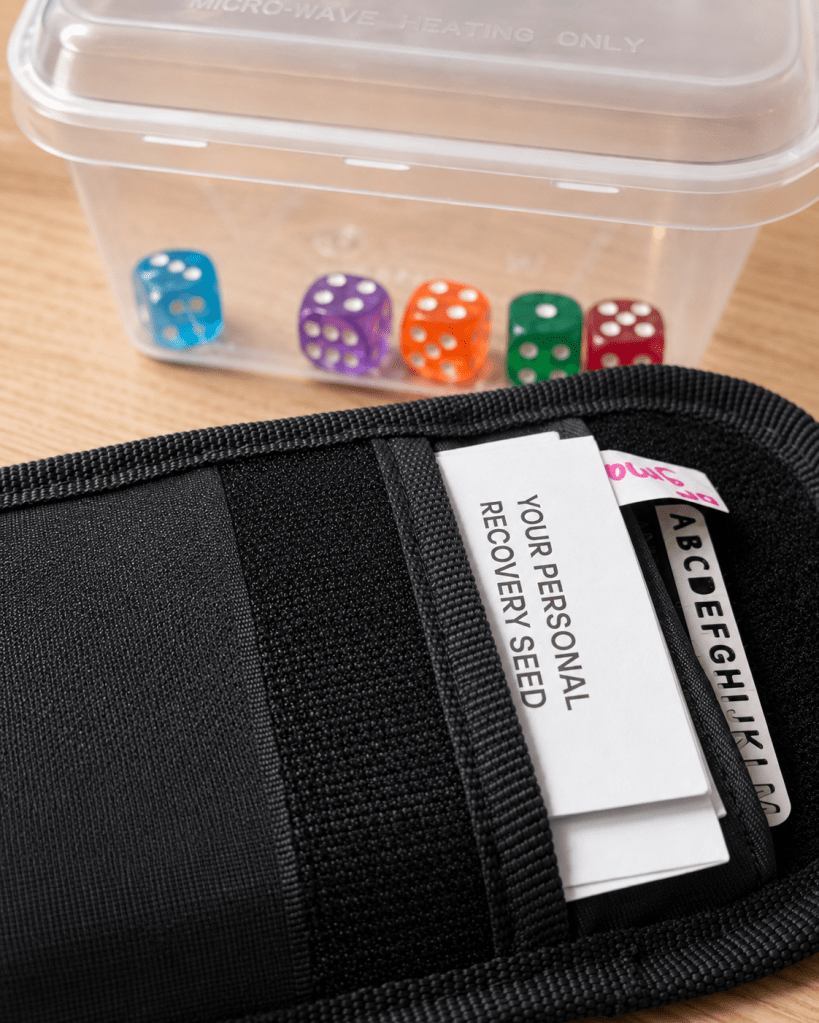
I bought physical dice.
Not electronic dice.
Not a website.
Not an app.
Actual dice.
I wanted a source of randomness that I could physically observe.
Roll.
Record.
Roll again.
And again.
There is something strangely reassuring about randomness coming from an object sitting in front of you.
The dice weren’t being used to replace Trezor’s wallet-generation process. That is an important distinction.
Instead, I used Diceware to create a much stronger wallet passphrase.
Diceware lets physical dice choose words from a predefined list instead of allowing my brain to invent something supposedly “random.” Trezor itself describes Diceware as an offline method of creating high-entropy passwords and passphrases, with each Diceware word contributing roughly 12.9 bits of entropy when generated properly. (Trezor)
Humans are terrible random-number generators.
Dice are much better.
So I rolled.
And rolled.
And rolled.
What started as a hardware-wallet news story had suddenly turned into me sitting at a table generating entropy manually.
Bitcoin does funny things to people.
A Passphrase Became My Second Independent Wall
A sufficiently strong BIP39 passphrase is interesting because it isn’t merely another password protecting the same wallet.
It derives a completely different wallet from the underlying seed.
That gives me something valuable psychologically and cryptographically: an additional secret that wasn’t generated by the hardware wallet’s RNG.
The COLDCARD advisory itself makes this point in another context. Coinkite states that a strong, unique BIP39 passphrase provides an independent barrier even when the underlying seed entropy is weakened, although affected COLDCARD users are still advised to migrate. (COINKITE Blog)
That made the concept click for me.
My Trezor seed could remain one component.
My independently generated high-entropy Diceware passphrase could become another.
I am not claiming this somehow “fixes” a hypothetical defective seed generator.
Nor am I claiming there is evidence that my Trezor’s RNG was defective.
There isn’t.
What I wanted was defence in depth.
One assumption failing should not immediately equal my retirement disappearing.
Then I Realised My Backup Was Also a Security Problem
Once you start pulling this thread, unfortunately, it doesn’t stop.
A stronger wallet is useless if the backup system is weak.
So my attention moved from electronic attacks to something much more primitive:
The $5 wrench attack.
Someone doesn’t need a quantum computer if they know you own significant Bitcoin.
They may simply need to threaten you.
That completely changes the security model.
A beautifully secured hardware wallet sitting beside a perfectly engraved recovery seed is excellent protection against device failure.
It may be terrible protection against coercion if everything required to access the Bitcoin is stored together.
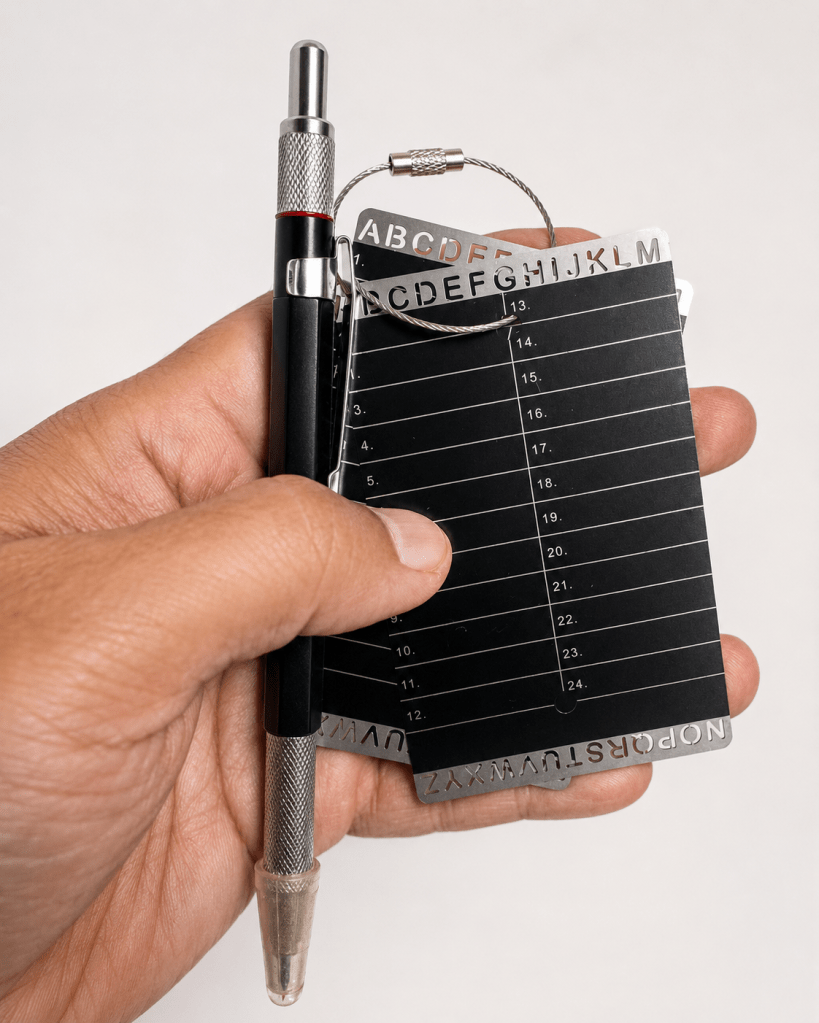
So I started reviewing my physical backup arrangement too.
Seed location.
Passphrase location.
Device location.
Redundancy.
Fire.
Water.
Theft.
Coercion.
What happens if I die.
What happens if my wife needs to recover the Bitcoin without me.
What happens if one backup disappears.
What happens if someone discovers one component.
And perhaps most importantly:
Does finding one thing give an attacker everything?
The answer should ideally be no.
Self-Custody Isn’t Just About Preventing Theft
There are two opposite ways to lose Bitcoin.
You can make security too weak and someone steals it.
Or you can make security so complicated that you eventually lock yourself out.
The second one concerns me just as much as the first.
I could create an absurd system involving numerous passphrases, geographically separated plates, hidden wallets and memorised secrets.
It might be incredibly difficult for an attacker to defeat.
It might also be incredibly difficult for my wife to recover if something happens to me.
Security that cannot survive its owner is not good retirement planning.
So my objective has changed.
I’m no longer asking:
“How do I make my Bitcoin impossible to steal?”
I’m asking:
“How do I build a system that is extremely difficult to steal, extremely difficult to accidentally lose, and still recoverable by my wife if I’m not here?”
Those are very different questions.
Which Led Me Down the Multisig Rabbit Hole
Naturally, I started learning about multisignature wallets.
With multisig, one seed or device doesn’t necessarily control everything.
A 2-of-3 setup, for example, could require any two of three independent keys to move the Bitcoin.
One compromised key isn’t enough.
One lost key isn’t necessarily catastrophic either.
That sounds attractive for a larger, long-term Bitcoin position.
But multisig brings its own complexity.
Multiple hardware wallets.
Multiple backups.
Wallet descriptors.
Recovery procedures.
Geographic separation.
Testing.
Inheritance documentation.
And the possibility of making an operational mistake years later after forgetting exactly how I originally configured everything.
Multisig can eliminate one category of single point of failure while quietly introducing new ones.
So I’m learning before moving anything.
Bitkey Suddenly Became Interesting
This also led me to look more seriously at Bitkey.
Bitkey takes a different approach from a traditional seed-phrase hardware wallet.
It uses a 2-of-3 multisignature architecture.
One key resides on the phone.
One resides on the Bitkey hardware device.
And the third is held by Bitkey’s server infrastructure.
Two keys are needed to move the Bitcoin, and because the user controls two of the three, Bitkey says the company cannot move the Bitcoin by itself. (Bitkey)
The current Bitkey design also includes recovery mechanisms, inheritance features and an Emergency Exit Kit intended to allow users to exit even if Bitkey itself becomes unavailable. (Bitkey)
That doesn’t automatically make Bitkey “better” than Trezor.
It solves a different problem.
Traditional Trezor-style self-custody gives me enormous control, but it also gives me enormous responsibility.
Bitkey tries to distribute that responsibility across several independent keys and recovery paths.
I’m exploring both philosophies.
Maybe There Isn’t One Perfect Hardware Wallet
That might be the biggest thing I’ve learned.
I used to think the question was:
Which hardware wallet is safest?
Now I think that’s the wrong question.
A Trezor could be excellent hardware sitting inside a terrible backup strategy.
A multisig wallet could be cryptographically brilliant but so complicated that the owner makes a recovery mistake.
A titanium seed backup could survive a house fire while simultaneously becoming a perfect target for anyone who discovers it.
A 20-character passphrase could defeat brute force and defeat the owner’s surviving spouse at the same time.
Bitcoin security is a system.
The hardware wallet is only one component.
The Incident Forced Me to Overhaul Everything
Ironically, the COLDCARD incident may ultimately improve the security of Bitcoin that has never touched a COLDCARD.
It made me question assumptions I had stopped questioning.
It pushed me to learn more deeply about entropy.
It pushed me toward physical dice and Diceware.
It pushed me toward a stronger passphrase.
It pushed me to rethink where my backups are stored.
It made me think seriously about coercion.
It made me study multisig.
It made me explore Bitkey.
It made me think about inheritance.
And it forced me to consider something uncomfortable:
What happens to our Bitcoin if I am suddenly no longer around to manage it?
For a Bitcoin balance that might eventually become retirement money, that’s not paranoia.
That’s responsibility.
There Is No Customer Support
This is the part of Bitcoin self-custody that gets lost in all the excitement about being your own bank.
Being your own bank sounds empowering.
Being your own bank’s:
- cybersecurity department,
- disaster-recovery team,
- fraud department,
- vault manager,
- inheritance planner,
- backup administrator,
- and customer-support department
sounds considerably less glamorous.
But that’s the deal.
If I make a catastrophic mistake, Bitcoin isn’t going to know that I worked for decades to accumulate those sats.
The network doesn’t know they represent retirement savings.
It doesn’t know I have a wife.
It doesn’t care that I made an innocent mistake.
Bitcoin simply enforces possession of the keys.
My New Philosophy: Assume Something Will Eventually Fail
Hardware can fail.
Companies can fail.
Software can contain bugs.
Houses can burn.
Backups can disappear.
People forget things.
People die.
Attackers adapt.
And even highly respected security products can occasionally reveal vulnerabilities years after deployment.
So instead of designing my Bitcoin security around the assumption that every component will work forever, I now want to design it around the opposite assumption:
Something will eventually go wrong.
The goal is to make sure that no single failure takes everything with it.
For me, that means continuing to learn before making major changes, strengthening independent layers of security, improving my backups, testing recovery and seriously thinking about how my wife would access our Bitcoin without depending entirely on knowledge stored inside my head.
Bitcoin Has No Undo Button
The COLDCARD RNG incident didn’t make me abandon hardware wallets.
It made me respect self-custody more.
There is a huge difference.
I still trust good hardware-wallet engineering.
I still use Trezor.
But I no longer want trust in one device to be my entire security strategy.
My dice are now part of the story.
My passphrase is stronger.
My backup system is being reconsidered.
Multisig is no longer something I dismiss as being only for corporations or whales.
Bitkey is on my research list.
And my Bitcoin setup is slowly becoming less like a gadget sitting in a drawer and more like what it actually is:
a personal financial vault that may need to protect my wife and me for the rest of our lives.
There is no customer support for that.
There is just preparation.
And perhaps being frightened into reviewing everything once in a while isn’t such a bad thing.




Leave a Reply